
Start With the Canvas: Eye Shapes
Every great set starts with reading the eye, not picking a style. Before you touch a map, identify what you're working with:
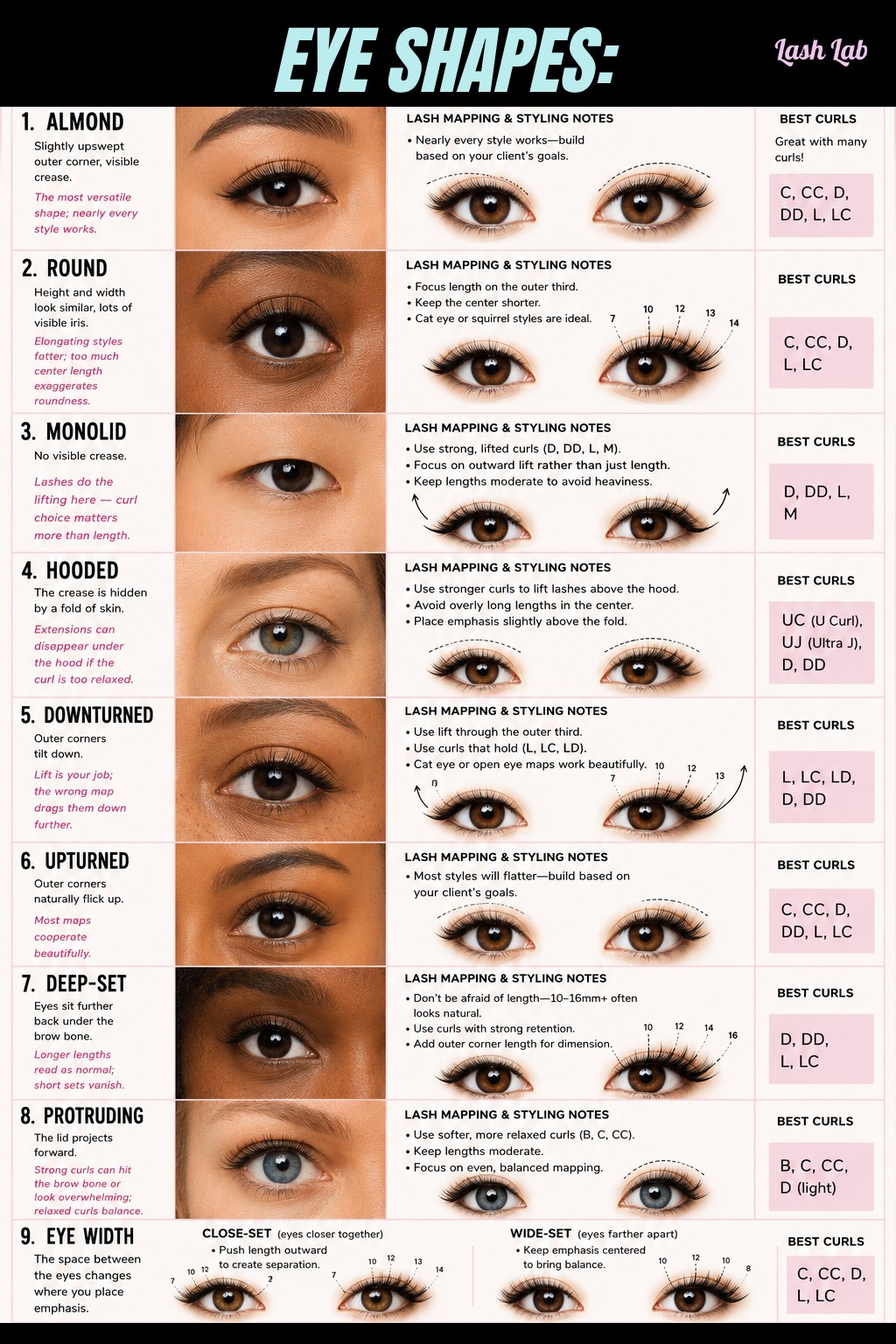
- Almond — slightly upswept outer corner, visible crease. The most versatile shape; nearly every style works.
- Round — height and width look similar, lots of visible iris. Elongating styles flatter; too much center length exaggerates roundness.
- Monolid — no visible crease. Lashes do the lifting here — curl choice matters more than length.
- Hooded — the crease is hidden by a fold of skin. Extensions can disappear under the hood if the curl is too relaxed.
- Downturned — outer corners tilt down. Lift is your job; the wrong map drags them down further.
- Upturned — outer corners naturally flick up. Most maps cooperate beautifully.
- Deep-set — eyes sit further back under the brow bone. Longer lengths read as normal; short sets vanish.
- Protruding — the lid projects forward. Strong curls can hit the brow bone or look overwhelming; relaxed curls balance.
- Close-set / Wide-set — the space between the eyes changes where you place emphasis: push length outward to separate close-set eyes, keep emphasis centered to balance wide-set eyes.
Eyelids Change Everything
Two clients with the same eye shape can need completely different sets because of their lids. Check for:
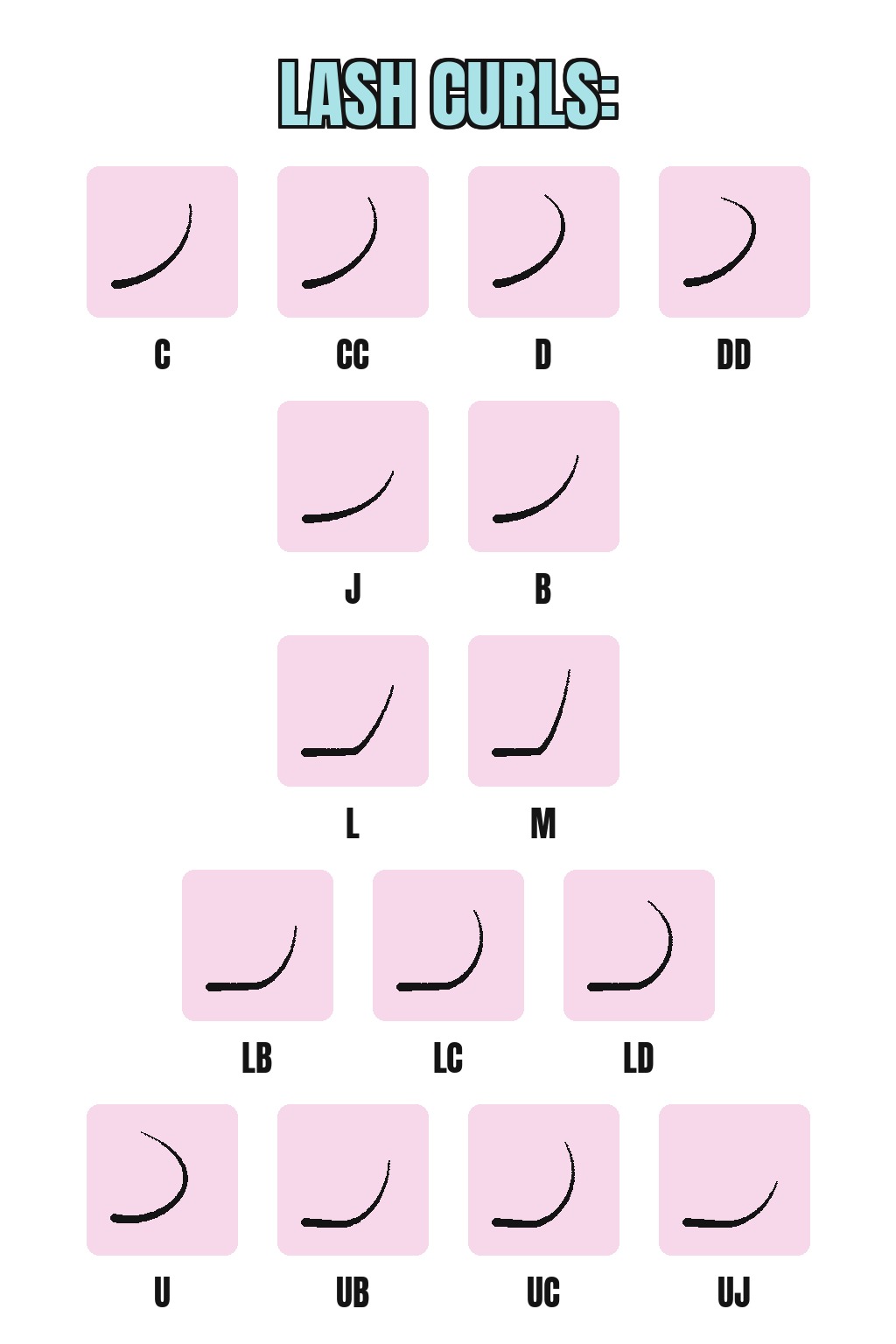
- Monolids — a stronger curl (C, CC, D) opens the eye since there's no crease to create depth.
- Hooded lids — the hood swallows soft curls. M or L curls kick straight out from the base and stay visible; avoid relying on length alone, because length hides under the fold.
- Mature or textured lids — skin may sit on the lash line. Lighter weights and lifted curls keep the set from feeling heavy or scratchy.
- Deep crease / plenty of lid space — you have room to play; most curls and maps will show.
Don't Forget the Brows
The brow frames the finished look. A high, arched brow gives you vertical room for dramatic curls and length. A straight or low-set brow means strong D curls can look cramped against the brow bone — a longer, more horizontal map often flatters more than a tall one. When the brow tail drops down, avoid maps that also drop at the outer corner; the eye will look pulled down. Always look at lashes and brows together in the mirror at consult.
Natural Lash Curls — and What to Pair With Them
Natural lashes grow in patterns, and extensions retain best when the curl works with that pattern:
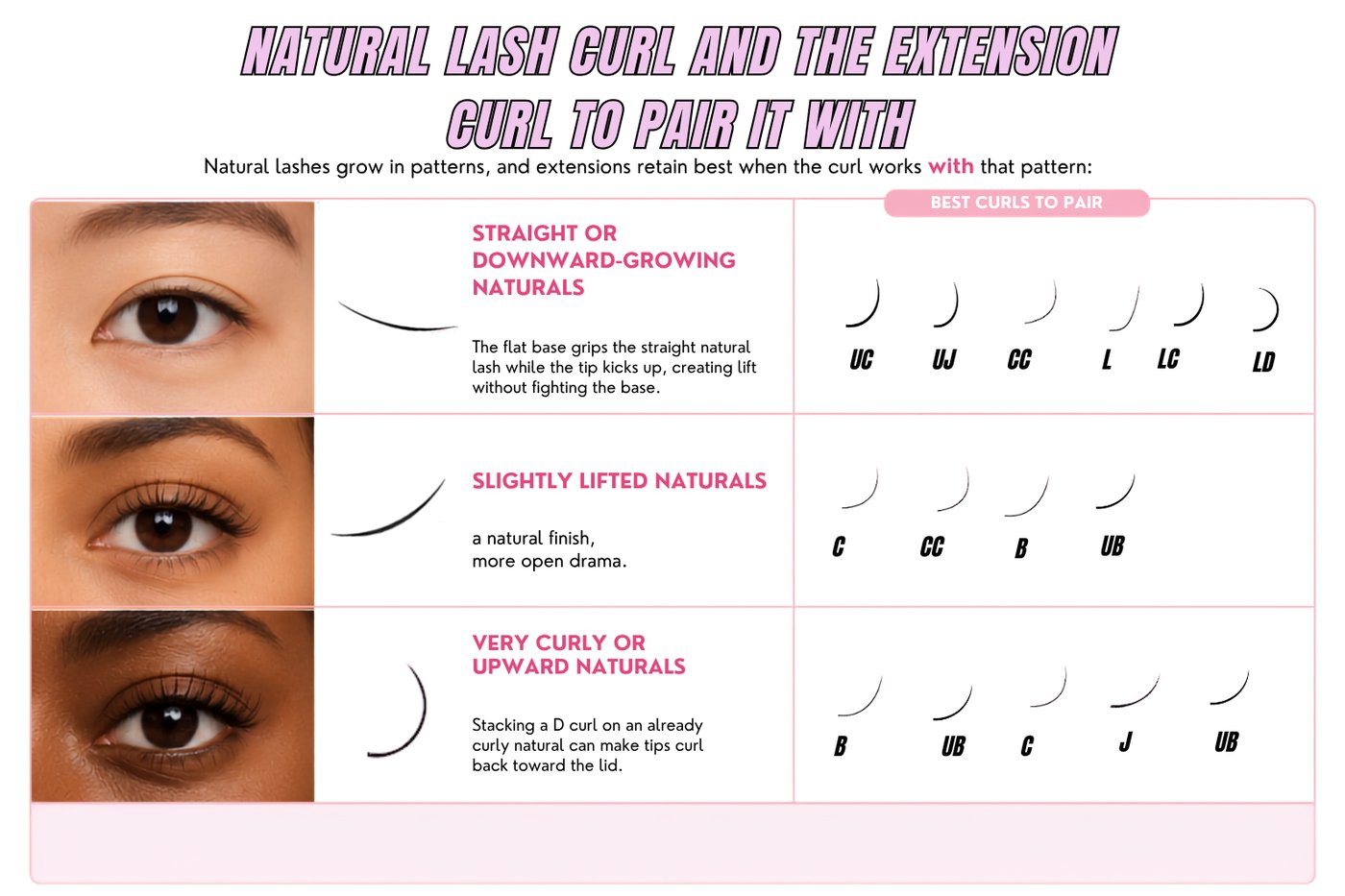
- Straight or downward-growing naturals — pair with M curl or L curl. The flat base grips the straight natural lash while the tip kicks up, creating lift without fighting the base.
- Slightly lifted naturals — pair with B or C curl for a natural finish, CC for more open drama.
- Very curly or upward naturals — pair with B, C, or J curl. Stacking a D curl on an already-curly natural can make tips curl back toward the lid.
Rule of thumb: the straighter the natural, the more aggressive the curl base needs to be (M/L family). The curlier the natural, the more relaxed your extension curl should be.
Maps to Avoid for Certain Eye Shapes
- Downturned eyes — avoid classic cat-eye maps (longest lengths at the very outer corner). They exaggerate the droop. Shift your longest lengths to the outer third, not the corner, and taper down at the very end.
- Round eyes — avoid doll maps that stack the longest lengths dead-center; they make round eyes rounder. Elongate instead.
- Hooded eyes — avoid maps that depend on long, soft curls to show the shape. The hood eats them. Build the shape with curl, not just length.
- Protruding eyes — avoid strong D/DD curls across the whole eye; they amplify projection. Relaxed curls with an elongated map balance the profile.
- Close-set eyes — avoid inner-corner emphasis or heavy inner density; it visually pulls the eyes closer together.
Choosing Length: Protect the Natural Lash
Extensions should stay within roughly 1.5× the length of the natural lash — beyond that, leverage and weight strain the follicle and retention suffers. If a client's naturals are 7mm, a 14–15mm extension is a science problem, not a style choice. Measure the naturals at consult, especially inner corners where lashes are shortest and weakest, and taper your map accordingly. Longer isn't more skilled — appropriate is more skilled.
Choosing Widths (Diameters) on Natural Lash Health
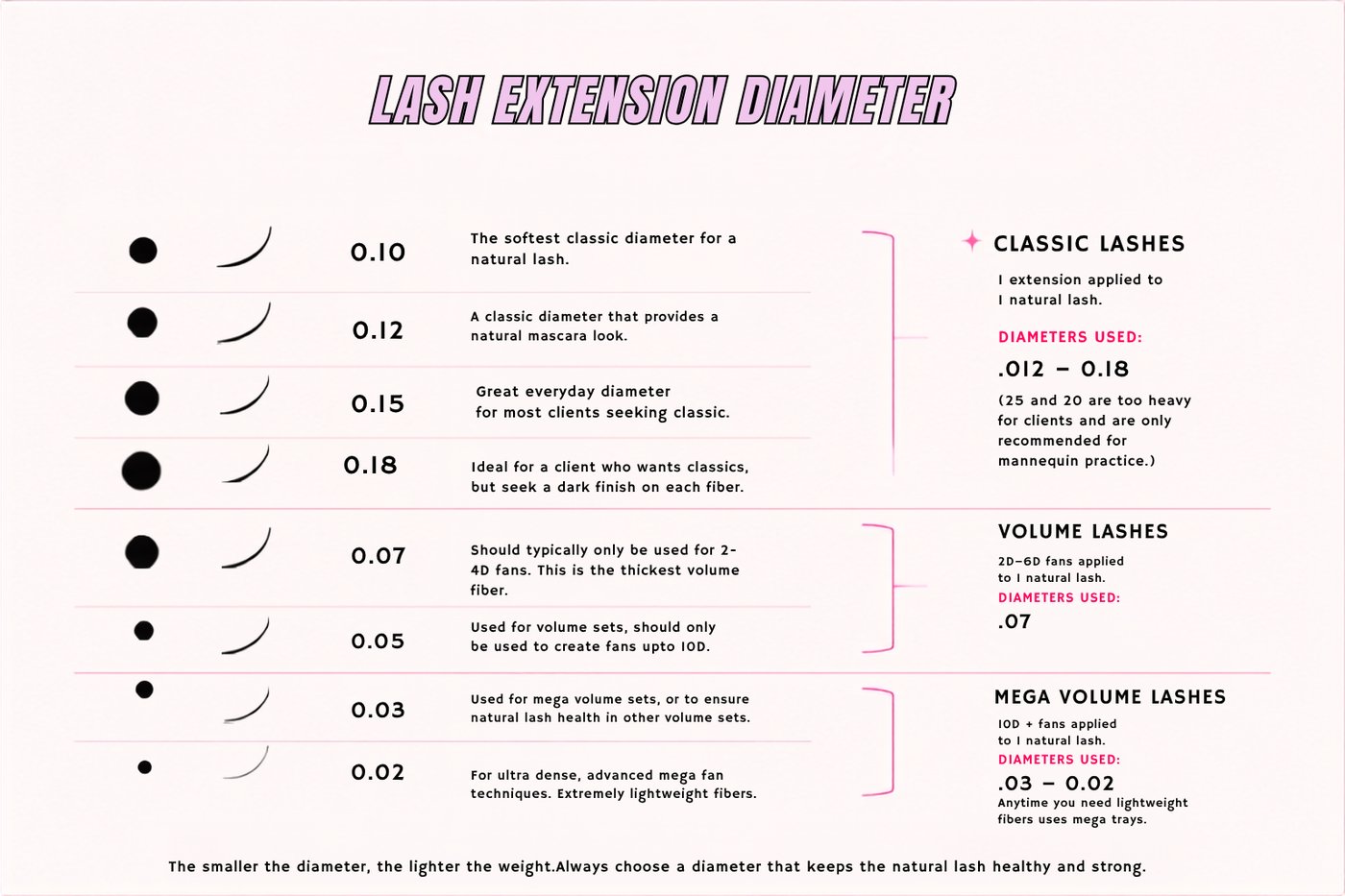
Diameter is where lash health is won or lost:
- Strong, healthy naturals — can support 0.15 classics or heavier volume fans.
- Average naturals — 0.12 classics, or volume in 0.05–0.07.
- Fine, weak, or sparse naturals — drop to 0.10 classics or lightweight volume in 0.03–0.05. The total weight of a fan must not exceed what one natural lash can carry.
When in doubt, go lighter. A slightly less dramatic set that retains beautifully beats a heavy set that sheds in a week and thins the naturals on its way out.
The Core Lash Styles, Defined
Every map is built on the same five zones across the lash line — inner corner (A), outer corner (B), middle of the eye (C), and the midpoints between them (D1, D2). Lengths are assigned per zone:
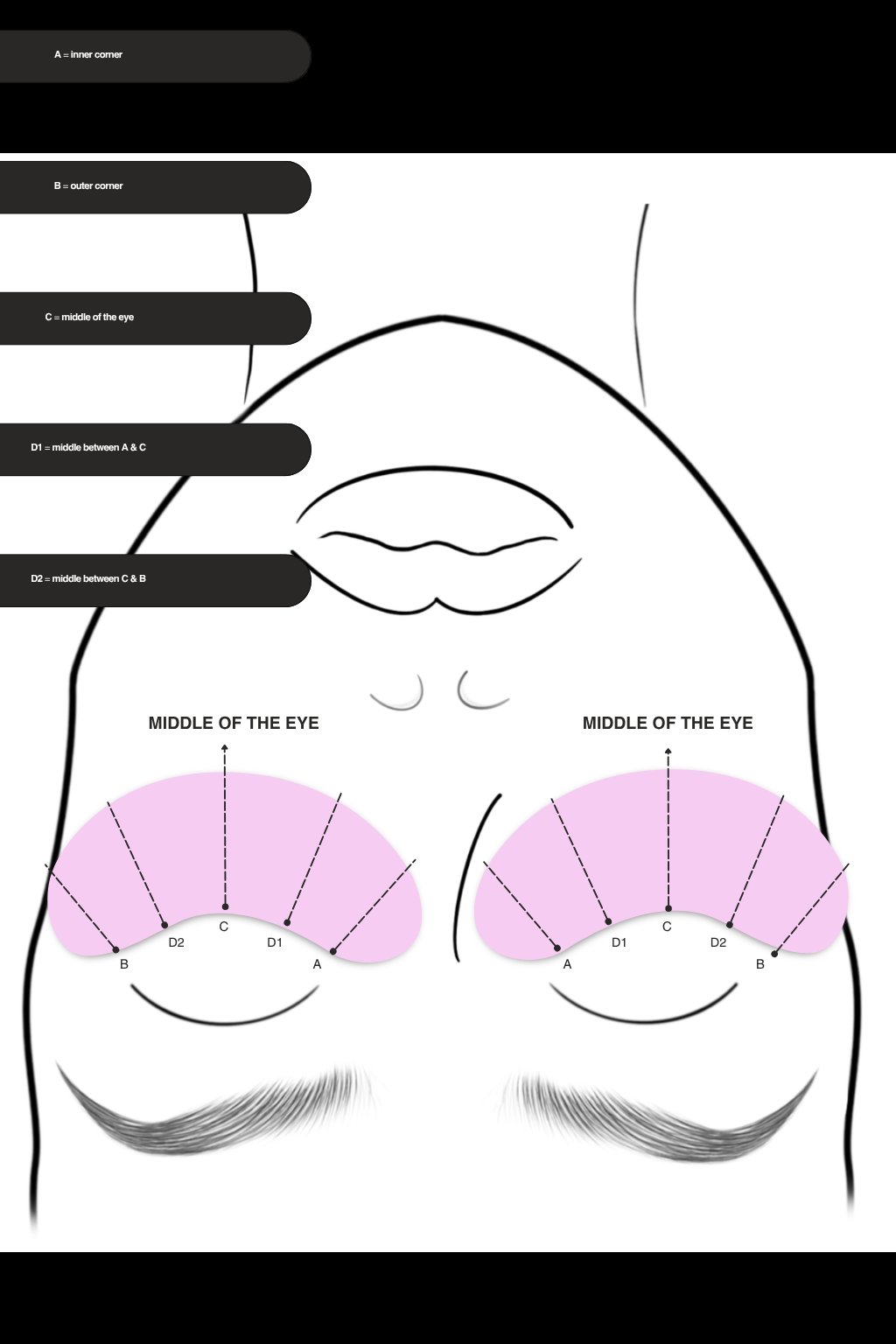
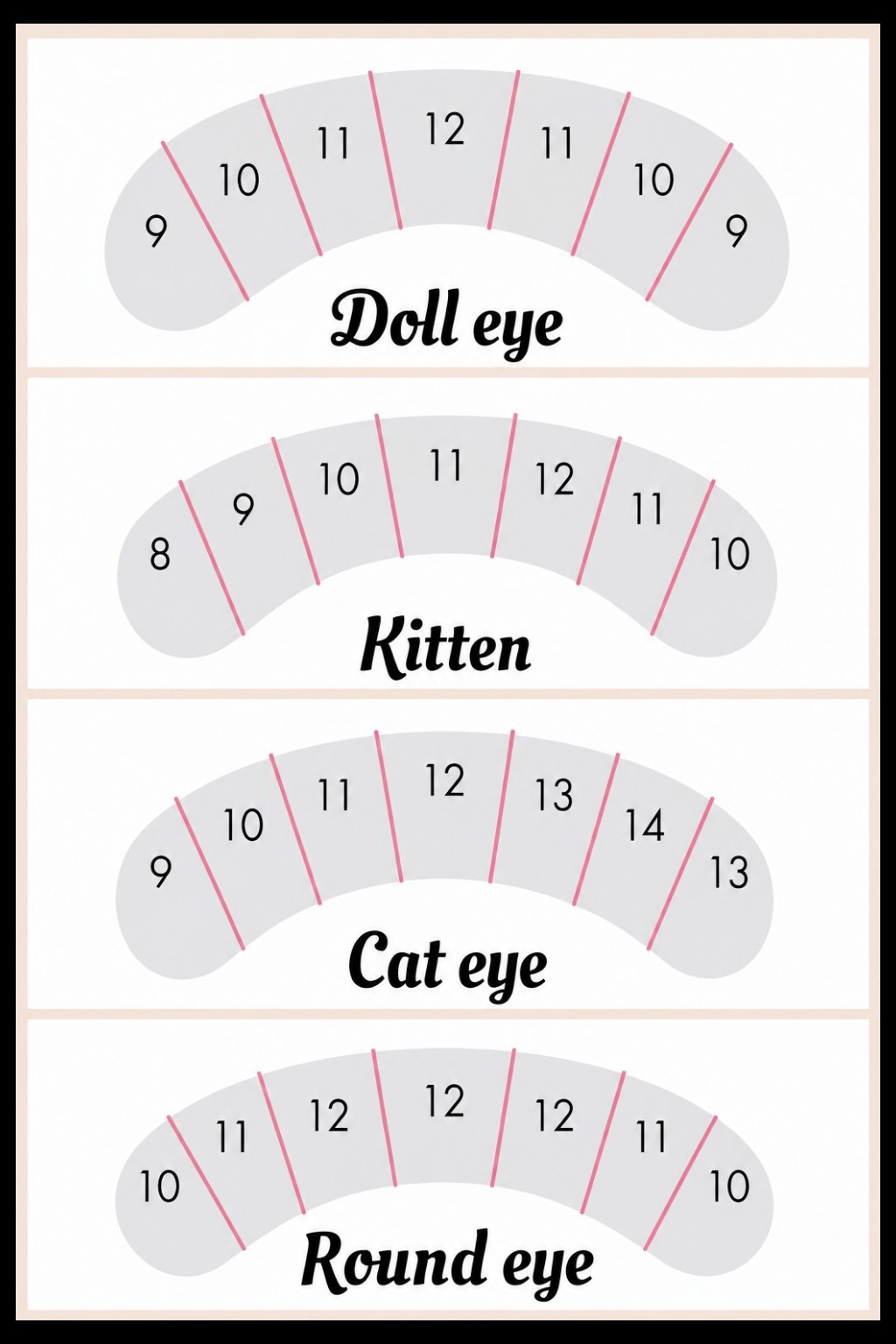
- Cat Eye — lengths build gradually from the inner corner and peak at the outer third to outer corner, creating a winged, lifted, sultry effect. Think eyeliner flick, in lash form.
- Doll Eye — longest lengths in the center of the eye, tapering shorter toward both corners. Opens the eye wide-awake and round, like a doll's.
- Kitten / Squirrel Eye — the in-between. Lengths peak just past the center (over the outer edge of the iris), then taper slightly at the corner. Gives lift like a cat eye without the drag risk — the most universally flattering map.
- Round / Open Eye — fairly even lengths across the eye with a gentle center emphasis. Soft, natural, uniform — maximizes openness without a directional shape.
Here's how those four styles translate to actual maps:
Lash Texture, Defined
Texture is the intentional variation within a set — mixing lengths, curls, or spike placement so the set has dimension instead of a perfectly uniform "strip lash" finish. A textured set might alternate 10mm and 12mm in the same zone, mix a C and CC curl, or weave closed spikes through soft fans. Texture is what makes a set look like lashes rather than a solid curtain — and it's the foundation of wispy, wet-look, and anime styles.
Anime Lashes — Origin & What They Are
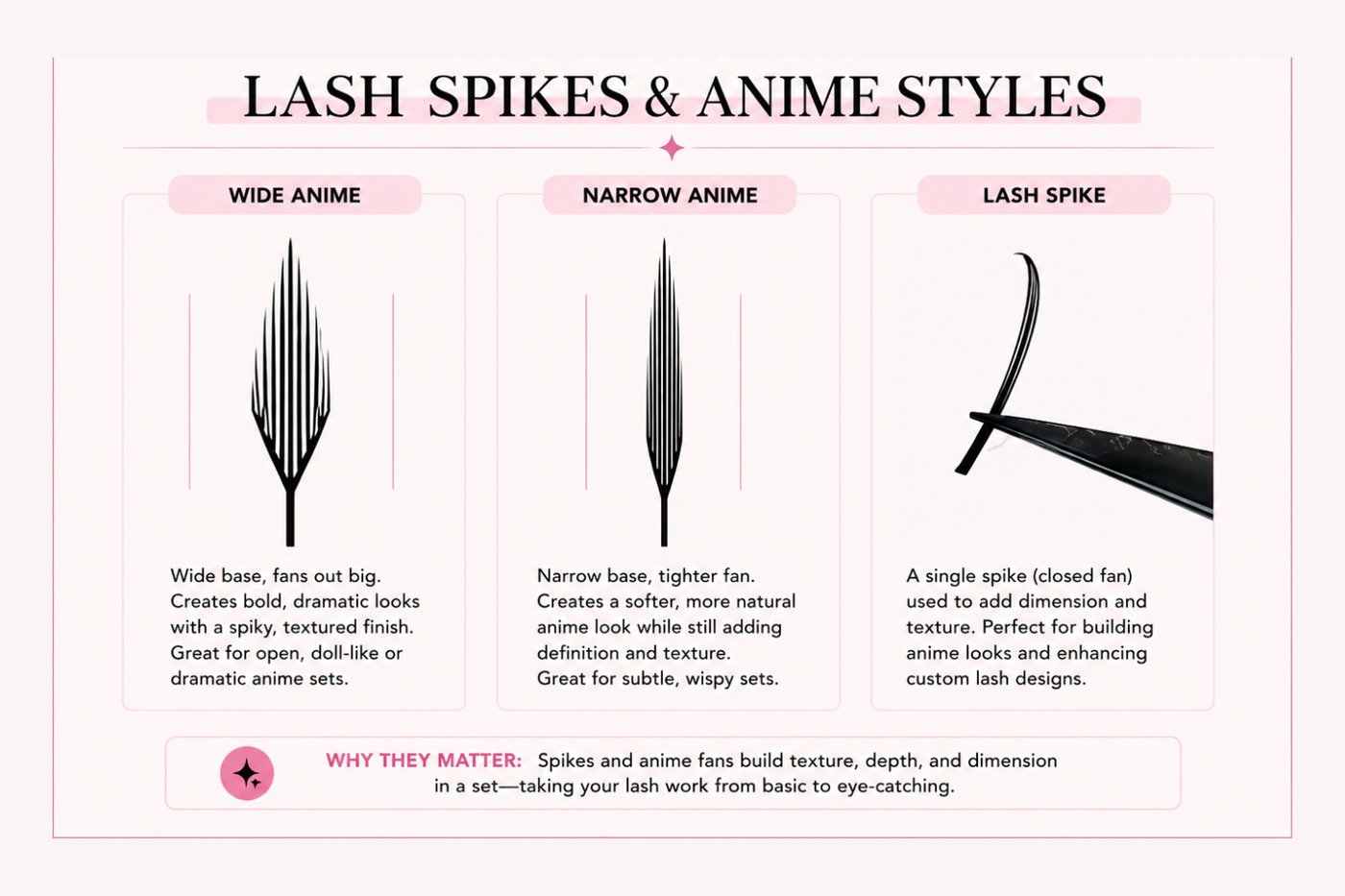
Anime lashes take their inspiration straight from Japanese animation, where characters' eyes are drawn with bold, separated clumps of lash rather than an even fringe. The look crossed from manga and anime into Japanese and Korean beauty trends — spiky, doll-like "manhwa" eyes — and then exploded globally through social media. In extension form, anime sets are built on dramatic, closed spikes at regular intervals with sparse or very lightweight coverage between them, so the eye reads as bright, wide, and illustrated. They pair naturally with doll or round maps for that wide-awake animated finish.
Adding Wisps & Spikes
Wisps and spikes are the texture tools:
- Spikes — closed, pointed clusters (lashes glued into a single tapered point) placed at intervals through the set.
- Wisps — softer variation created by alternating lengths around those spikes so the set flows rather than stripes.
Place spikes evenly — every 2–3mm across the lash line — and keep their curl consistent with the base set so they integrate rather than float.
Prominent vs. Peekaboo Wisps
The drama level of a wispy set is a dial, and it's set by how far your spikes rise above the base:
- Prominent wisps & spikes — spikes run about 5 lengths longer than the base of the set (base 10mm → spikes 15mm). The spikes are unmissable — this is the bold, editorial, anime-adjacent finish.
- Peekaboo wisps & spikes — spikes sit about 3 lengths above the base (base 10mm → spikes 13mm). They peek through the set for soft, feathery dimension — texture you notice second, not first.
Ask the client: do you want the spikes to be the first thing people see, or a detail they catch up close? That answer picks the dial for you.
Close the Consult Like a Pro
Before you pick up a tweezer, identify the four things the client is actually asking for: the length, the curl, the amount of volume, and the style. Then repeat it back to them, along with the mapping you'll use:
"So you're looking for a natural-to-medium length, lifted curl, medium volume, in a kitten-eye shape — I'll map you at 8mm inner, peaking 11mm just past your iris, tapering to 10mm at the corner. Sound right?"
That one sentence prevents 90% of "this isn't what I wanted" moments. The client hears their own request confirmed, you've set the expectation, and you both signed off on the same set before it exists. For the full walkthrough, see the Lash Consultation Guide.
Master Mapping Hands-On
Styling clicks fastest when someone maps an eye in front of you. That's exactly what happens in the Lash Masterclass with Ms. Hood.
Explore Training →